
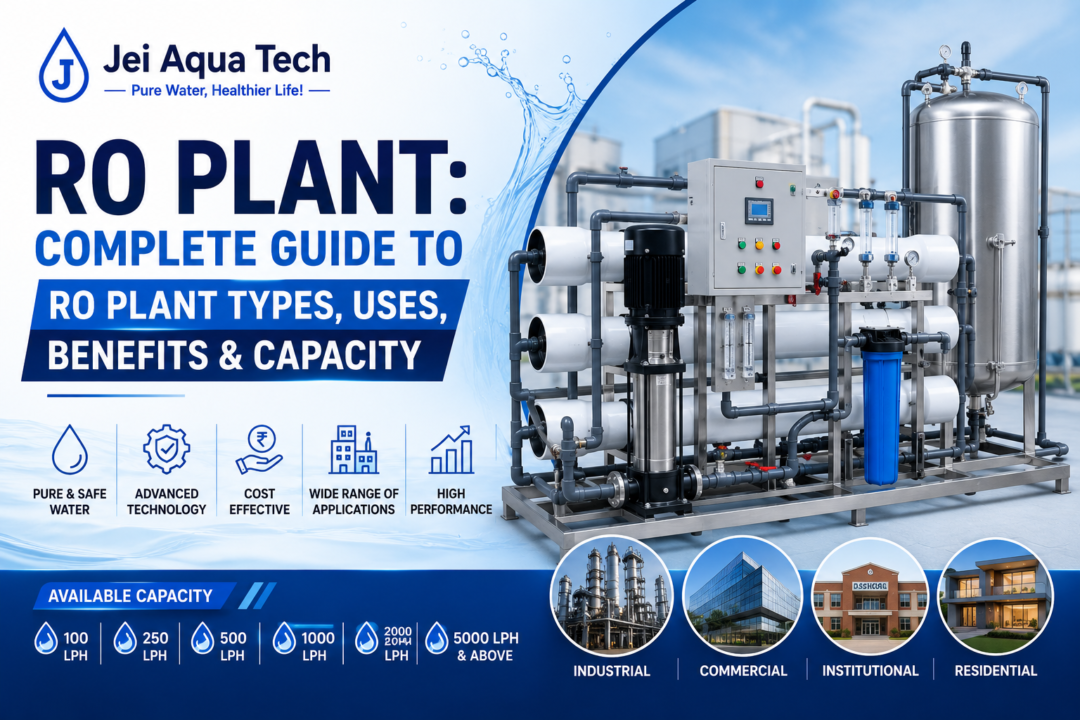
Access to clean and purified water is essential for homes, businesses, industries, hospitals, hotels, schools, restaurants, and commercial establishments. When water contains dissolved salts, impurities, chemicals, microorganisms, and other unwanted substances, a reliable water purification system is required. An RO Plant (Reverse Osmosis Plant) is one of the most effective water treatment solutions for producing high-quality purified water.
At Jei Aqua Tech, we provide different types of RO Plants designed to meet the water purification requirements of commercial and industrial applications. Depending on your daily water requirement, available capacities include 100 LPH, 250 LPH, 500 LPH, 1000 LPH, 2000 LPH, 3000 LPH, and 5000 LPH RO Plants.
What Is an RO Plant?
An RO Plant is a water purification system that uses Reverse Osmosis technology to remove dissolved impurities from water. The system works by using pressure to push water through a semi-permeable RO membrane. The membrane allows water molecules to pass through while reducing many dissolved salts, minerals, contaminants, and other unwanted substances.
RO Plants are commonly used where a higher quantity of purified water is required. They can be installed for commercial establishments, manufacturing units, hotels, hospitals, educational institutions, restaurants, apartments, packaged drinking water applications, and other locations.
The capacity of an RO Plant is generally measured in LPH (Litres Per Hour). For example, a 500 LPH RO Plant can produce approximately 500 litres of purified water per hour under suitable operating conditions.
How Does an RO Plant Work?
An RO Plant generally consists of multiple stages of water treatment. The exact configuration can vary depending on the source-water quality and application.
1. Pre-Filtration
Before water reaches the RO membrane, pre-treatment is used to reduce suspended particles, sediment, chlorine, organic matter, and other contaminants that may affect the performance of the RO membrane.
Sand filters and carbon filters are commonly used as part of pre-treatment depending on the water quality.
2. High-Pressure Pump
The high-pressure pump provides the pressure required to push the feed water through the RO membrane. Proper operating pressure is important for maintaining effective purification and consistent production.
3. RO Membrane
The RO membrane is the main purification component. It helps reduce dissolved salts, total dissolved solids (TDS), and various contaminants from the feed water.
4. Purified Water Collection
The treated water, commonly called permeate or purified water, is collected for the intended application. The remaining concentrated water is discharged or managed according to the system design.
Types of RO Plants Available
Different locations have different water requirements. Choosing the correct RO Plant capacity is important for achieving consistent water production without unnecessarily increasing operating costs.
100 LPH RO Plant
A 100 LPH RO Plant is suitable for applications that require a relatively smaller quantity of purified water. It can be considered for small commercial establishments, offices, clinics, restaurants, institutions, and other locations with moderate water requirements.
Its compact capacity makes it useful when purified water demand is lower but a commercial-grade purification system is still required.
250 LPH RO Plant
The 250 LPH RO Plant provides a higher production capacity compared with smaller RO systems. It can be suitable for offices, restaurants, small hotels, schools, commercial establishments, and other applications where a continuous supply of purified water is required.
The final system configuration should be selected according to feed-water quality, daily consumption, and operating requirements.
500 LPH RO Plant
A 500 LPH RO Plant is a popular option for commercial water purification applications. It can produce approximately 500 litres of purified water per hour under suitable operating conditions.
This capacity can be useful for restaurants, hotels, schools, hospitals, offices, apartments, and commercial establishments with regular purified-water requirements.
1000 LPH RO Plant
A 1000 LPH RO Plant is designed for applications requiring a larger volume of purified water. It can produce approximately 1000 litres per hour under suitable operating conditions.
This type of system may be suitable for hotels, hospitals, industries, large commercial establishments, educational institutions, and other facilities with higher water consumption.
2000 LPH RO Plant
The 2000 LPH RO Plant is designed for higher-volume commercial and industrial water purification requirements. With a production capacity of approximately 2000 litres per hour, it can support applications where a continuous supply of purified water is required.
Industries and larger commercial facilities can select this capacity based on their daily water consumption and process requirements.
3000 LPH RO Plant
A 3000 LPH RO Plant is suitable for applications that require approximately 3000 litres of purified water per hour under suitable operating conditions.
It can be considered for larger industries, hotels, institutions, manufacturing facilities, and commercial applications where water demand is significantly higher.
5000 LPH RO Plant
The 5000 LPH RO Plant is one of the higher-capacity systems available for large-scale water purification requirements. It can produce approximately 5000 litres of purified water per hour under suitable conditions.
This capacity can be suitable for industries, large commercial establishments, manufacturing units, hotels, institutions, and other facilities requiring a high volume of treated water.
How to Choose the Right RO Plant Capacity?
Choosing an RO Plant should not be based only on the plant’s LPH capacity. Several factors should be considered before selecting the system.
Daily Water Requirement
Calculate how much purified water is required every day. A plant that is too small may not meet your demand, while an unnecessarily large plant can increase installation and operating costs.
Raw Water Quality
The quality of the incoming water is one of the most important factors. Borewell water, municipal water, surface water, and other sources may have different TDS levels and contaminants.
A water test can help determine the appropriate treatment process and pre-treatment requirements.
TDS Level
High TDS water may require an RO system with appropriate membrane selection and operating pressure. Testing the feed water before installation helps in designing a suitable system.
Application
The required RO Plant capacity depends on whether the purified water will be used for drinking water, food processing, manufacturing, hotels, hospitals, institutions, or other commercial purposes.
Operating Hours
A facility operating for several hours per day may have different requirements from one that needs purified water continuously. Operating schedules should therefore be considered when selecting the LPH capacity.
Benefits of Installing an RO Plant
Installing a properly designed RO Plant can provide several benefits for commercial and industrial applications.
Effective Water Purification: RO technology helps reduce dissolved salts and many unwanted contaminants from water.
Consistent Water Quality: A properly maintained RO Plant can provide a consistent supply of treated water for the intended application.
Suitable for Different Applications: RO Plants are available in different capacities, making them suitable for small commercial requirements as well as larger industrial applications.
Improved Water Quality: Reduction of excessive dissolved impurities can improve the overall quality of treated water.
Scalable Capacity Options: Different capacities such as 100 LPH, 250 LPH, 500 LPH, 1000 LPH, 2000 LPH, 3000 LPH, and 5000 LPH make it easier to select a system according to water demand.
Why Is RO Plant Maintenance Important?
Regular maintenance is essential for maintaining the performance and efficiency of an RO Plant. Over time, filters and membranes can become affected by sediment, scaling, fouling, and other contaminants.
Routine RO Plant maintenance may include:
- Checking the pre-treatment filters
- Inspecting the RO membrane
- Checking operating pressure
- Inspecting pumps and valves
- Monitoring TDS levels
- Checking water flow
- Cleaning or replacing filters when required
- Checking electrical components
- Inspecting pipelines and connections
- Monitoring overall system performance
The maintenance frequency depends on the raw-water quality, plant usage, operating conditions, and system configuration.
RO Plant Installation and Service
Professional installation is important for ensuring that an RO Plant operates correctly. The system should be selected and configured according to the feed-water characteristics, required production capacity, available space, and intended application.
At Jei Aqua Tech, we provide RO Plant solutions for different commercial and industrial water purification requirements. Our available capacities include:
- 100 LPH RO Plant
- 250 LPH RO Plant
- 500 LPH RO Plant
- 1000 LPH RO Plant
- 2000 LPH RO Plant
- 3000 LPH RO Plant
- 5000 LPH RO Plant
We can help customers identify a suitable RO Plant based on water quality, daily consumption, required production capacity, and application.
Conclusion
An RO Plant is an effective solution for commercial and industrial water purification requirements. Since every application has different water consumption and raw-water characteristics, selecting the correct plant capacity is important.
Whether you require a 100 LPH RO Plant, 250 LPH RO Plant, 500 LPH RO Plant, 1000 LPH RO Plant, 2000 LPH RO Plant, 3000 LPH RO Plant, or 5000 LPH RO Plant, the right system should be selected based on water quality, daily demand, operating hours, and application.
With proper installation, regular maintenance, and timely replacement of filtration components, an RO Plant can provide a reliable supply of purified water for commercial and industrial needs.
Jei Aqua Tech offers RO Plant solutions and water treatment services designed to meet different water purification requirements. Contact us to discuss your water requirement and identify the suitable RO Plant capacity for your application.

Written by Seoadmin

-
Sale Product on sale
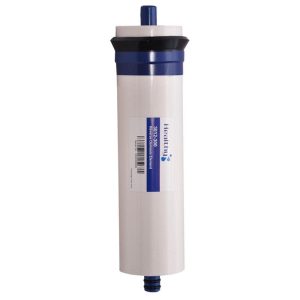
 300 GPD Hi-Tech RO Membrane
₹ 3,500Original price was: ₹ 3,500.₹ 2,700Current price is: ₹ 2,700. -
Sale Product on saleVontron 300 Gpd RO Membrane
₹ 3,500Original price was: ₹ 3,500.₹ 3,000Current price is: ₹ 3,000. -
Sale Product on sale300 Gpd Healthy RO Membrane
₹ 4,200Original price was: ₹ 4,200.₹ 3,700Current price is: ₹ 3,700. -
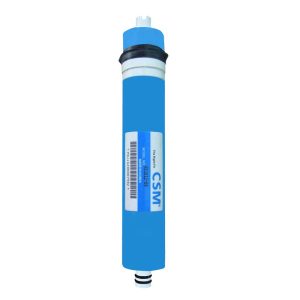
Sale Product on saleCsm 80 GPD Membrane
₹ 2,500Original price was: ₹ 2,500.₹ 1,600Current price is: ₹ 1,600.

-
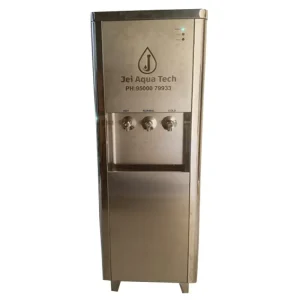
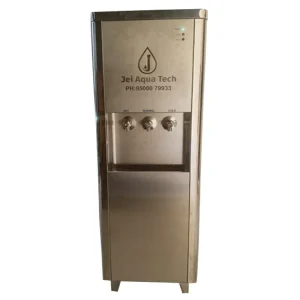
Sale Product on sale50 LPH RO+Hot+Cold Water Dispenser
₹ 82,000Original price was: ₹ 82,000.₹ 75,000Current price is: ₹ 75,000. -
Sale Product on sale25 LPH RO+Hot+Cold Water Dispenser
₹ 66,000Original price was: ₹ 66,000.₹ 64,900Current price is: ₹ 64,900. -
Sale Product on saleNormal+Hot+Cold Water Dispenser
₹ 58,500Original price was: ₹ 58,500.₹ 57,800Current price is: ₹ 57,800.
Leave a Reply
You must be logged in to post a comment.