
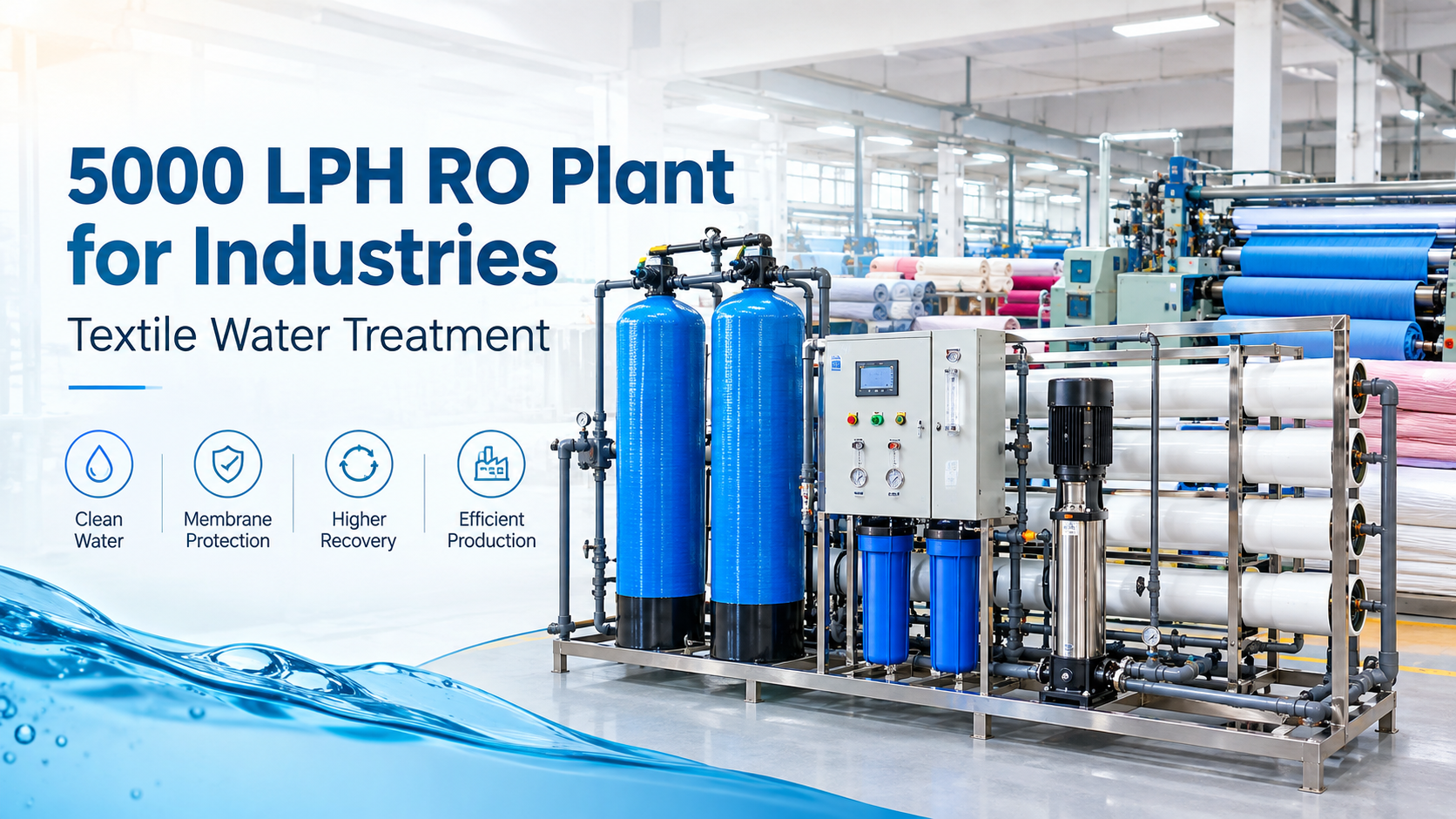
Textile industries require large quantities of water for processes such as dyeing, washing, bleaching, printing, and finishing. Because the quality of processed water can directly affect production, fabric quality, equipment performance, and wastewater management, many textile factories use industrial water treatment systems.
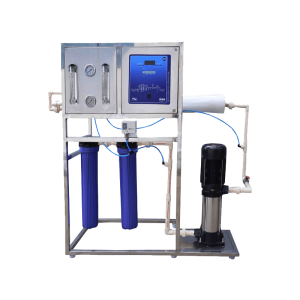
A 5000 LPH RO Plant for industries is designed to produce approximately 5,000 litres of treated water per hour. For textile applications, the RO system is generally combined with suitable pre-treatment to protect the membranes and improve overall water recovery.
This guide explains how a 5000 LPH RO Plant for textile industry applications works, the importance of pre-treatment, water recovery, and factors to consider when planning an industrial RO system.
Why Textile Industries Need RO Water Treatment
Textile manufacturing can involve several water-intensive processes. Depending on the production method, the incoming water may contain hardness, suspended solids, iron, organic matter, dissolved salts, and other contaminants.
Using untreated or poorly treated water can contribute to:
- Scaling on equipment and pipelines
- Membrane fouling
- Colour and process inconsistencies
- Higher chemical consumption
- Frequent equipment maintenance
- Reduced efficiency of downstream treatment systems
An industrial RO plant helps reduce dissolved contaminants and produces treated water suitable for applications where consistent water quality is required.
What Is a 5000 LPH RO Plant?
A 5000 LPH RO Plant has a nominal production capacity of around 5,000 litres of permeate water per hour under its designed operating conditions.
For example:
5,000 litres/hour × 8 hours = approximately 40,000 litres/day
Actual daily production depends on operating hours, feed-water quality, membrane condition, recovery rate, and system design.
For textile factories, the plant may be operated continuously or according to production requirements.
Typical Pre-Treatment for Textile RO Plants
Pre-treatment is one of the most important parts of an industrial RO system. RO membranes should not be expected to handle raw water directly.
A typical treatment arrangement may include:
Raw Water → Raw Water Tank → Pressure Sand Filter → Activated Carbon Filter → Micron Filter → Cartridge Filter → High-Pressure Pump → RO Membranes → Permeate Storage
The exact configuration should be selected after analysing the source-water quality.
1. Pressure Sand Filter
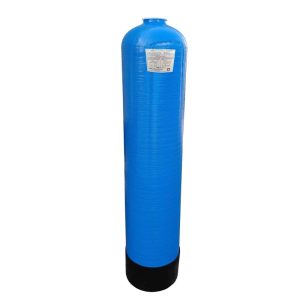
A pressure sand filter helps remove suspended particles, turbidity, and other larger impurities from the feed water.
This stage reduces the particulate load entering the downstream equipment and helps protect RO membranes.
2. Activated Carbon Filter
An activated carbon filter can reduce chlorine, organic compounds, unpleasant odours, and certain impurities.
Chlorine control is particularly important when polyamide RO membranes are used because excessive exposure to free chlorine can damage the membrane.
3. Water Softener
If the source water has significant hardness, a water softener may be included in the pre-treatment system.
Reducing hardness helps control calcium and magnesium scaling on the RO membranes.
4. Micron and Cartridge Filtration
Fine filtration provides an additional barrier against suspended particles before the water reaches the RO membranes.
Cartridge filters are commonly used as the final pre-filtration stage.
How Does Water Recovery Work?
RO recovery refers to the percentage of feed water converted into permeate.
For example, if a system receives 6,250 litres of feed water and produces 5,000 litres of permeate:
Recovery = 5,000 ÷ 6,250 × 100 = 80%
The remaining water becomes rejected or concentrated.
The achievable recovery of a textile RO system depends on feed-water chemistry, membrane configuration, scaling potential, operating conditions, and the required permeate quality.
A higher recovery rate is not automatically better. The system must be designed so that excessive concentration of salts and other contaminants does not cause scaling or membrane fouling.
Water Recovery and Reuse in Textile Industries
Water recovery is increasingly important for industries where water consumption is high.
Depending on the factory’s process and water quality requirements, treated water may potentially be reused for suitable applications such as:
- Process water
- Washing operations
- Boiler feed pre-treatment
- Utility applications
- Cleaning
- Cooling-related applications
- Other non-potable industrial processes
The exact reuse application should be determined from the required water-quality specifications.
Important Factors When Designing a 5000 LPH RO Plant
A 5000 LPH RO plant should not be selected based only on the required output capacity.
Several technical factors need to be evaluated.
Feed-Water Quality
Before selecting the RO configuration, test parameters such as:
- TDS
- pH
- Total hardness
- Calcium
- Magnesium
- Iron
- Manganese
- Turbidity
- Chlorine
- Silica
- Sulphate
- Alkalinity
- Microbiological parameters where applicable
The water analysis helps determine the appropriate pre-treatment and membrane configuration.
Required Permeate Quality
The required quality of treated water depends on how the water will be used inside the textile facility.
Water intended for a particular manufacturing process may have different requirements from water used for general utility purposes.
Operating Hours
A factory operating an RO plant for 8 hours per day has very different production requirements from one operating continuously.
The total daily requirement should therefore be calculated before selecting the system.
Recovery Requirement
The desired recovery should be balanced against feed-water characteristics and membrane operating limits.
A suitable design can help reduce water wastage while protecting membrane performance.
5000 LPH RO Plant Maintenance
Regular maintenance is essential for maintaining stable production and extending membrane life.
Important maintenance activities include:
- Monitoring feed and permeate pressure
- Checking permeate TDS
- Inspecting cartridge filters
- Maintaining the softener, where installed
- Checking pre-treatment performance
- Monitoring membrane differential pressure
- Cleaning RO membranes when required
- Checking pumps and electrical components
- Recording daily operating parameters
A sudden increase in permeate TDS, pressure drop, or reduction in permeate flow can indicate membrane fouling, scaling, or another system problem.
Why Proper Pre-Treatment Matters
The RO membrane is one of the most important and sensitive components of the system. Poor pre-treatment can cause premature fouling and scaling.
A properly designed pre-treatment system can help:
Reduce suspended solids → Control chlorine → Reduce hardness → Protect membranes → Maintain permeate quality
For textile industries, this becomes particularly important because source-water conditions and production requirements can vary significantly between factories.
5000 LPH RO Plant for Industries from Jei Aqua Tech
Jei Aqua Tech provides industrial water treatment solutions for commercial and industrial applications. A 5000 LPH RO Plant for industries can be designed according to the source-water characteristics, required treated-water quality, operating hours, and application requirements.
For textile factories, the system can be planned with appropriate pre-treatment and water-recovery considerations rather than using a standard RO configuration for every installation.
Before installing a 5000 LPH RO Plant for textile industry, conduct a detailed water analysis and calculate the factory’s daily water requirement. This helps determine the appropriate membrane configuration, pre-treatment equipment, recovery rate, and overall plant design.
Conclusion
A 5000 LPH RO Plant for textile industry applications can provide a consistent source of treated water for various industrial requirements. However, the performance of the RO system depends heavily on proper pre-treatment, membrane selection, recovery design, and regular maintenance.
For textile factories looking to improve water treatment and reuse, a properly engineered 5000 LPH industrial RO plant can be integrated with suitable filtration and pre-treatment stages based on the factory’s actual water-quality requirements.
Jei Aqua Tech can help evaluate the application, source-water quality, treatment requirements, and capacity needed for an industrial RO plant installation.

Written by Seoadmin
-
Sale Product on sale
 300 GPD Hi-Tech RO Membrane
₹ 3,500Original price was: ₹ 3,500.₹ 2,700Current price is: ₹ 2,700. -
Sale Product on saleVontron 300 Gpd RO Membrane
₹ 3,500Original price was: ₹ 3,500.₹ 3,000Current price is: ₹ 3,000. -
Sale Product on sale300 Gpd Healthy RO Membrane
₹ 4,200Original price was: ₹ 4,200.₹ 3,700Current price is: ₹ 3,700. -
Sale Product on saleCsm 80 GPD Membrane
₹ 2,500Original price was: ₹ 2,500.₹ 1,600Current price is: ₹ 1,600.

-
Sale Product on sale50 LPH RO+Hot+Cold Water Dispenser
₹ 82,000Original price was: ₹ 82,000.₹ 75,000Current price is: ₹ 75,000. -
Sale Product on sale25 LPH RO+Hot+Cold Water Dispenser
₹ 66,000Original price was: ₹ 66,000.₹ 64,900Current price is: ₹ 64,900. -
Sale Product on saleNormal+Hot+Cold Water Dispenser
₹ 58,500Original price was: ₹ 58,500.₹ 57,800Current price is: ₹ 57,800.
Leave a Reply
You must be logged in to post a comment.