
Choosing the right pre-filter is an important part of designing an efficient RO plant. Before water reaches the RO membrane, it needs suitable pre-treatment to reduce suspended particles, turbidity, and other contaminants that can affect membrane performance.
Two commonly used options are sand filters and cartridge filters. While both can be used in RO pre-treatment, they serve different purposes and are often most effective when used together rather than treated as direct alternatives.
If you are planning an RO plant installation, understanding the difference between a sand filter and cartridge filter can help you select the right pre-treatment system for your water source and plant capacity.
What Is a Sand Filter for an RO Plant?
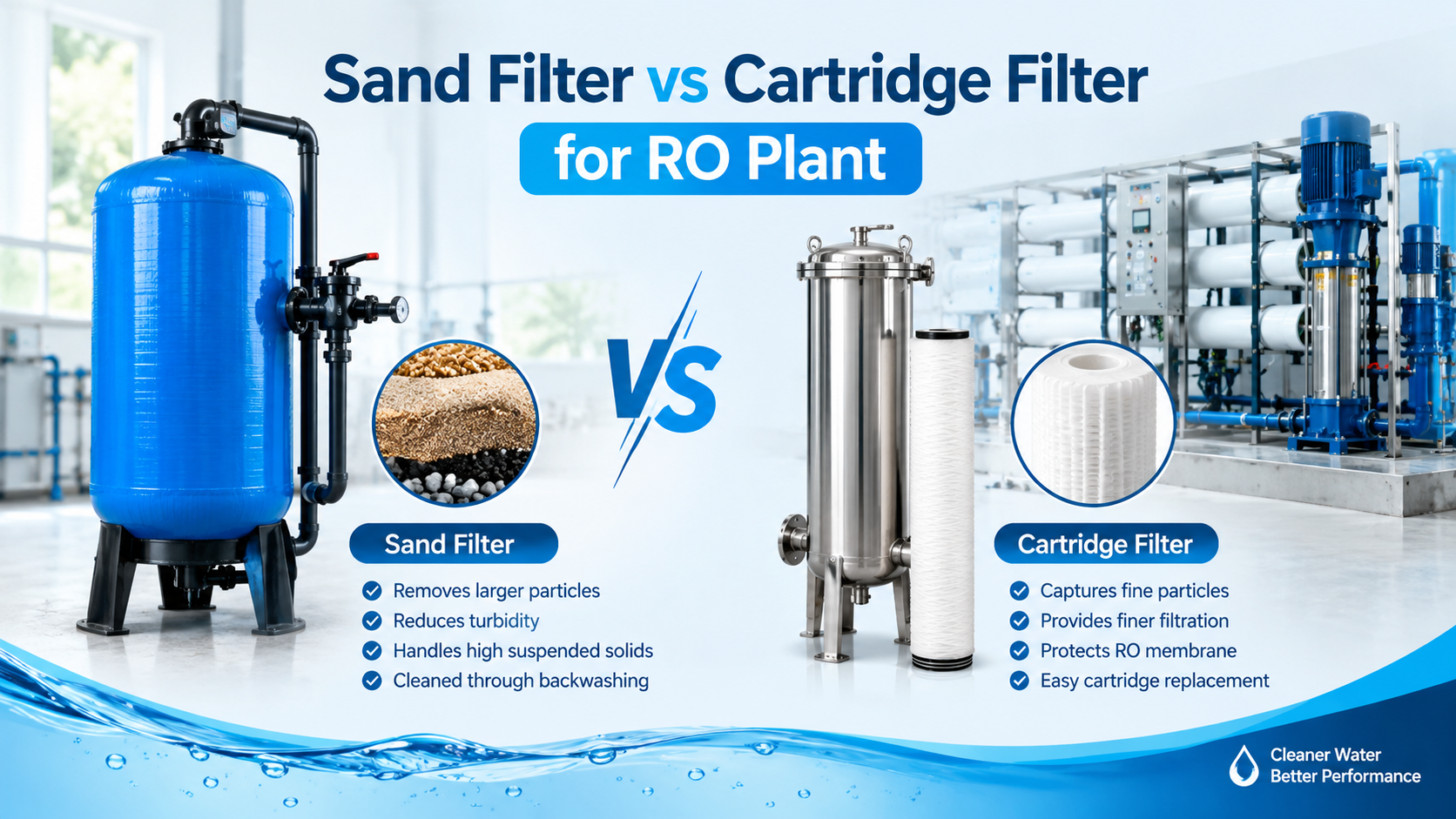
A sand filter, also known as a pressure sand filter, is generally used as an initial-stage filtration system. It contains layers of filtration media such as graded sand and other suitable media.
As raw water passes through the filter, suspended solids and larger particles are trapped within the media bed. This helps reduce turbidity and protects downstream treatment equipment.
A sand filter for RO plant applications is particularly useful when the incoming water contains higher levels of suspended particles, mud, dust, or visible turbidity.
Benefits of a Sand Filter
- Handles relatively high suspended-solid loads
- Reduces turbidity before RO treatment
- Protects downstream filters and equipment
- Suitable for borewell and other raw-water applications
- Can be cleaned through backwashing
- Useful for commercial and industrial RO systems
However, a sand filter is not designed to remove every type of dissolved contaminant. Additional treatment may be required depending on the raw-water quality.
What Is a Cartridge Filter?
A cartridge filter is usually installed after larger-particle filtration as a finer polishing stage. It uses a replaceable filter cartridge to capture smaller suspended particles before water enters sensitive equipment such as the RO membrane.
Common cartridge filter ratings include 1, 5, 10, and 20 microns, depending on the application and required filtration level.
Cartridge filters are compact and relatively simple to install. However, their service life can become shorter when they receive heavily turbid water without adequate upstream filtration.
Benefits of a Cartridge Filter
- Provides finer particulate filtration
- Compact and easy to install
- Helps protect RO membranes from fine particles
- Available in different micron ratings
- Cartridge replacement is straightforward
- Suitable as a final pre-filtration stage
The main limitation is that cartridges can become clogged quickly when raw water contains a high concentration of suspended solids.
Sand Filter vs Cartridge Filter: Key Differences
Feature | Sand Filter | Cartridge Filter |
Main purpose | Bulk suspended-solid removal | Fine particulate filtration |
Filtration stage | Usually an early pre-treatment stage | Usually a later pre-treatment stage |
Handles high turbidity | Better suited | Can clog quickly |
Cleaning | Backwashing | Cartridge replacement |
Installation | Requires pressure vessel and valves | Compact housing |
Operating role | Protects downstream filtration | Final particulate protection |
Best use | Raw water with suspended solids | Fine filtration before RO |
This comparison shows that choosing between the two should depend on your raw-water characteristics rather than simply selecting one filtration method.
Can Sand Filter and Cartridge Filter Be Used Together?
Yes. In many RO plants, using both systems provides more effective pre-treatment.
A typical arrangement can be:
Raw Water → Sand Filter → Activated Carbon Filter → Cartridge Filter → RO Membrane
The sand filter handles larger suspended particles and turbidity. An activated carbon filter may then be used where chlorine, organic compounds, or unpleasant odour need to be addressed. Finally, the cartridge filter provides finer particulate filtration before the RO membrane.
The exact configuration should be determined from raw-water testing and the requirements of the RO system.
Which Filter Is Better for Borewell Water?
Borewell water quality can vary significantly from one location to another. Some borewell sources may contain high turbidity or suspended particles, while others may have problems such as iron, hardness, or dissolved salts.
For water with significant suspended solids, a sand filter for RO plant pre-treatment can provide useful bulk filtration. A cartridge filter can then be used as a polishing stage.
If the borewell water contains iron, hardness, or other dissolved contaminants, simply installing a sand filter may not solve the problem. Additional treatment such as an iron removal system, water softener, or other suitable pre-treatment may be required.
Which Pre-Filter Should You Choose for Your RO Plant?
There is no universal answer because RO pre-treatment should be designed according to the characteristics of the incoming water.
Consider these factors before selecting a system:
1. Raw-Water Quality
Test turbidity, TDS, hardness, iron, chlorine, pH, and other relevant parameters. Water testing helps identify the appropriate treatment stages.
2. RO Plant Capacity
A small commercial RO system and a high-capacity industrial RO plant may require completely different pre-treatment arrangements.
3. Suspended Solids
If the water contains substantial suspended particles, a pressure sand filter can reduce the load reaching finer filtration stages.
4. Maintenance Requirements
Sand filters require periodic backwashing, while cartridge filters require regular cartridge replacement based on pressure drop and water quality.
5. Membrane Protection
The primary objective of RO pre-treatment is to reduce contaminants that can cause fouling, scaling, or premature membrane performance problems.
Final Takeaway
A sand filter and cartridge filter are not necessarily competing filtration systems. They often perform different functions within an RO plant.
A sand filter is generally used for bulk removal of suspended particles and turbidity, while a cartridge filter provides finer particulate filtration before water reaches the RO membrane.
For many applications, the most practical approach is to use them as complementary stages rather than choosing only one. However, the correct configuration depends on raw-water test results, RO plant capacity, required water quality, and operating conditions.
If you are planning an RO plant installation or upgrading your existing pre-treatment system, Jei Aqua Tech can help assess your water-treatment requirements and recommend a suitable filtration arrangement based on the application.

Written by Seoadmin

-
Sale Product on sale
 300 GPD Hi-Tech RO Membrane
₹ 3,500Original price was: ₹ 3,500.₹ 2,700Current price is: ₹ 2,700. -
Sale Product on saleVontron 300 Gpd RO Membrane
₹ 3,500Original price was: ₹ 3,500.₹ 3,000Current price is: ₹ 3,000. -
Sale Product on sale300 Gpd Healthy RO Membrane
₹ 4,200Original price was: ₹ 4,200.₹ 3,700Current price is: ₹ 3,700. -
Sale Product on saleCsm 80 GPD Membrane
₹ 2,500Original price was: ₹ 2,500.₹ 1,600Current price is: ₹ 1,600.

-
Sale Product on sale50 LPH RO+Hot+Cold Water Dispenser
₹ 82,000Original price was: ₹ 82,000.₹ 75,000Current price is: ₹ 75,000. -
Sale Product on sale25 LPH RO+Hot+Cold Water Dispenser
₹ 66,000Original price was: ₹ 66,000.₹ 64,900Current price is: ₹ 64,900. -
Sale Product on saleNormal+Hot+Cold Water Dispenser
₹ 58,500Original price was: ₹ 58,500.₹ 57,800Current price is: ₹ 57,800.
Leave a Reply
You must be logged in to post a comment.