
Hard water is a common issue in many parts of India, especially in areas that depend on borewell and groundwater sources. High levels of calcium and magnesium can cause scale formation, reduce soap performance, affect plumbing, and shorten the life of appliances.
A water softener filter uses a resin-based ion exchange process to reduce hardness. Salt or brine is required to regenerate the resin and restore its softening capacity. However, not all types of salt are equally suitable for every water softener.
Understanding the available water softener salt types can help homeowners, apartments, commercial facilities, and industries choose the right option for their system.
Why Does a Water Softener Need Salt?
Most conventional water softeners use cation exchange resin. During normal operation, hardness-causing calcium and magnesium ions are exchanged with sodium ions held by the resin.
Over time, the resin becomes saturated with hardness minerals. A concentrated salt solution, called brine, is then passed through the resin during regeneration.
The salt itself does not directly remove hardness from the incoming water. Instead, it helps regenerate the resin so that the softener can continue operating effectively.
This makes selecting suitable water softener salt and supplies an important part of regular system maintenance.
Common Water Softener Salt Types
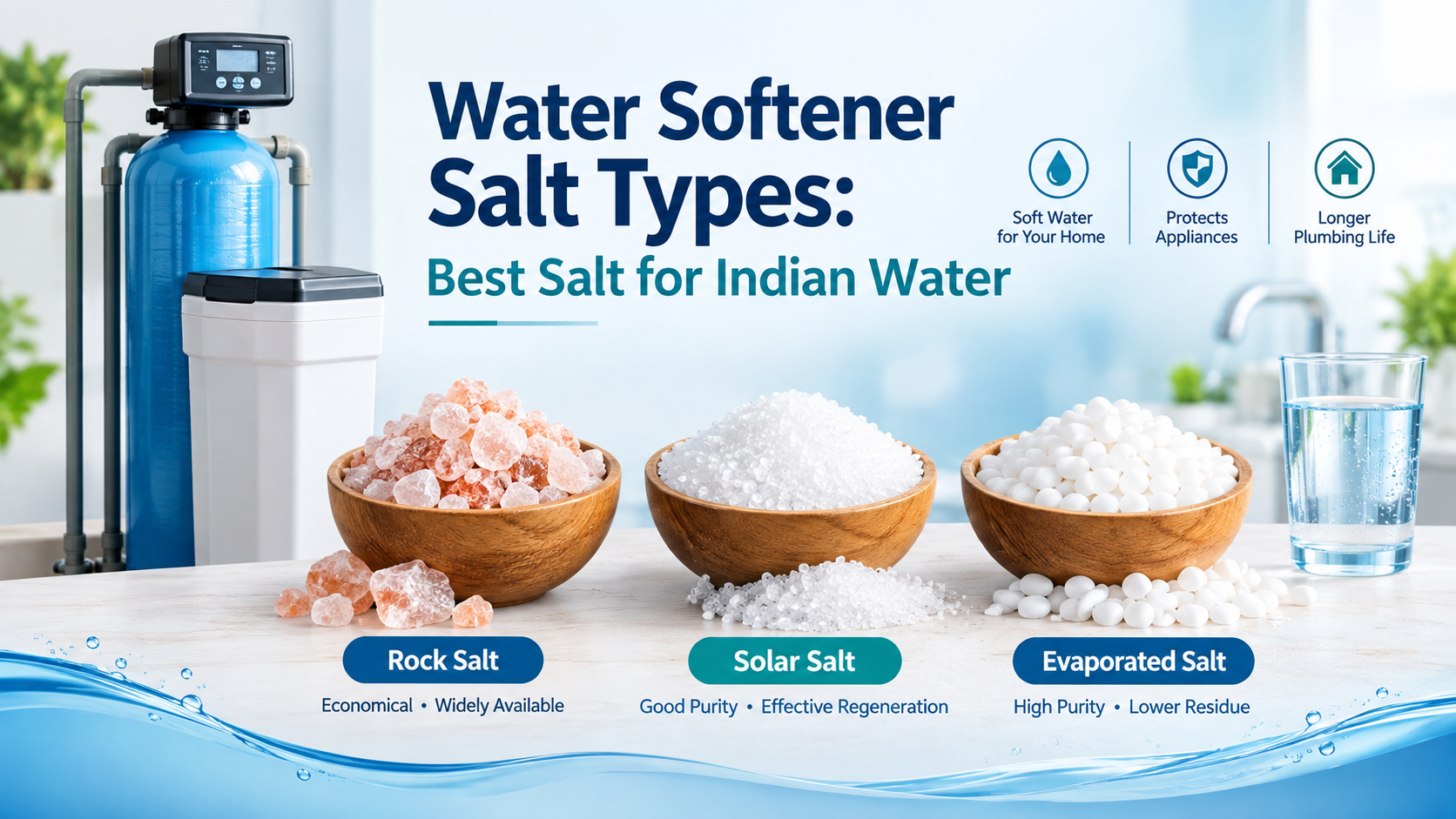
There are several forms of salt used for water softening. The most common options are rock salt, solar salt, and evaporated salt.
1. Rock Salt
Rock salt is mined from underground natural salt deposits and generally contains sodium chloride along with varying amounts of other minerals and insoluble material.
It is often one of the more economical options for large-capacity softeners.
Advantages:
- Generally lower purchase cost
- Suitable for many conventional softeners
- Available in bulk quantities
Limitations:
- May contain more impurities
- Can leave more insoluble residue in the brine tank
- May require more frequent tank cleaning
For a domestic softener with moderate usage, a cleaner salt option may be more convenient.
2. Solar Salt
Solar salt is produced by evaporating seawater or saline water using sunlight. It is commonly available as crystals or pellets.
Because it generally contains fewer impurities than many grades of rock salt, solar salt is widely used for residential and commercial softening systems.
Advantages:
- Good purity
- Effective regeneration
- Commonly available
- Suitable for many domestic systems
For many Indian homes, solar salt can be a practical choice when the product quality is reliable and compatible with the softener manufacturer’s recommendations.
3. Evaporated Salt
Evaporated salt is produced by dissolving salt and evaporating the resulting brine under controlled conditions. It is generally manufactured to a higher purity than ordinary rock salt.
It can provide efficient regeneration and produce less insoluble material compared with lower-purity salt.
Advantages:
- High purity
- Efficient resin regeneration
- Less residue
- Suitable for demanding applications
The main disadvantage is usually its higher cost.
Which Salt is Best for Indian Water Conditions?
There is no single salt that is automatically the best for every Indian water source.
The correct choice depends on factors such as:
- Incoming water hardness
- Daily water consumption
- Softener capacity
- Resin type
- Regeneration frequency
- Salt quality and availability
- Manufacturer recommendations
For many residential applications, good-quality solar salt or high-purity evaporated salt can be suitable choices.
Where water hardness is particularly high or the softener operates continuously, maintaining the correct regeneration schedule becomes more important than simply choosing the cheapest salt.
Does Borewell Water Require a Special Salt?
Borewell water can have high hardness, along with iron, manganese, turbidity, and other dissolved substances.
A water softener is primarily designed to address hardness. If the borewell water contains significant iron, manganese, suspended particles, or other contaminants, appropriate pre-treatment may be necessary.
For example, depending on the water quality, a treatment system may include:
Raw Water → Sediment/Sand Filtration → Iron Removal or Other Pre-treatment → Water Softener → Further Treatment
The exact arrangement should be selected after testing the raw water.
Using better-quality salt cannot compensate for inadequate pre-treatment or an incorrectly sized softener.
Salt Pellets vs Salt Crystals
Salt is available in different physical forms, including crystals, pellets, and blocks.
Pellets are often convenient because they dissolve consistently and can help reduce bridging and uneven salt dissolution when the product is manufactured properly.
Crystals can also work effectively in compatible systems.
The most important factor is not simply the shape but salt purity, suitability for the softener, and proper regeneration practices.
Always check the softener manufacturer’s specifications before changing salt types.
How Much Salt Does a Water Softener Use?
Salt consumption varies considerably between systems.
It depends on:
- Water hardness
- Quantity of water treated
- Softener resin volume
- Regeneration settings
- Desired treated-water hardness
- Efficiency of the control valve
A larger household or commercial installation may consume considerably more salt than a small domestic unit.
Instead of adding a fixed quantity based only on tank size, the regeneration cycle should be adjusted according to actual water consumption and hardness.
Signs That Your Softener Salt Needs Attention
Regular inspection of the brine tank is important.
Watch for:
- Low salt level – The system may not have enough salt for regeneration.
- Salt bridging – A hard crust can form above the remaining salt.
- Salt mushing – Dissolved salt can accumulate at the bottom of the tank.
- Visible impurities – Excess residue may indicate poor-quality salt.
- Increasing water hardness – Could indicate insufficient regeneration or another system issue.
If hardness starts appearing again in treated water, simply adding more salt may not always solve the problem. The resin, injector, brine system, control valve, and regeneration settings may also need inspection.
Tips for Buying Water Softener Salt in India
When purchasing water softener salt, consider the following:
Choose a suitable purity level
Higher-purity salt generally produces less insoluble residue and can reduce maintenance requirements.
Buy from a reliable supplier
Poor-quality or contaminated salt may create unnecessary deposits inside the brine tank.
Follow the manufacturer’s recommendation
Different softener designs can have different requirements.
Store salt properly
Keep salt dry and protected from rain or excessive moisture. Moisture can cause salt to clump and make handling more difficult.
Do not overfill the brine tank
Follow the recommended operating level instead of continuously filling the tank to maximum capacity.
Water Softener Salt and Supplies: Complete Maintenance
Salt is only one part of a water softener maintenance routine. A properly maintained system may also require:
- Brine tank cleaning
- Resin inspection
- Brine line inspection
- Injector cleaning
- Control valve servicing
- Hardness testing
- Regeneration setting checks
- Replacement of worn components
For borewell applications, periodic raw-water testing is particularly useful because water quality can vary between locations and over time.
Final Thoughts
Choosing the best salt for a water softener in India depends on water quality, system design, hardness level, operating conditions, and salt purity.
For many domestic applications, quality solar salt can provide a practical balance between performance and cost. Higher-purity evaporated salt may be appropriate where cleaner regeneration and reduced residue are priorities. Rock salt can be economical, but its impurity level should be considered.
Most importantly, salt selection should be combined with correct softener sizing, proper regeneration settings, and regular maintenance.
If you need help selecting water softener salt and supplies or planning a water softener system for hard or borewell water, Jei Aqua Tech can help assess the water-treatment requirement and recommend a suitable configuration for your application.

Written by Seoadmin

-
Sale Product on sale
 300 GPD Hi-Tech RO Membrane
₹ 3,500Original price was: ₹ 3,500.₹ 2,700Current price is: ₹ 2,700. -
Sale Product on saleVontron 300 Gpd RO Membrane
₹ 3,500Original price was: ₹ 3,500.₹ 3,000Current price is: ₹ 3,000. -
Sale Product on sale300 Gpd Healthy RO Membrane
₹ 4,200Original price was: ₹ 4,200.₹ 3,700Current price is: ₹ 3,700. -
Sale Product on saleCsm 80 GPD Membrane
₹ 2,500Original price was: ₹ 2,500.₹ 1,600Current price is: ₹ 1,600.

-
Sale Product on sale50 LPH RO+Hot+Cold Water Dispenser
₹ 82,000Original price was: ₹ 82,000.₹ 75,000Current price is: ₹ 75,000. -
Sale Product on sale25 LPH RO+Hot+Cold Water Dispenser
₹ 66,000Original price was: ₹ 66,000.₹ 64,900Current price is: ₹ 64,900. -
Sale Product on saleNormal+Hot+Cold Water Dispenser
₹ 58,500Original price was: ₹ 58,500.₹ 57,800Current price is: ₹ 57,800.

Leave a Reply
You must be logged in to post a comment.