
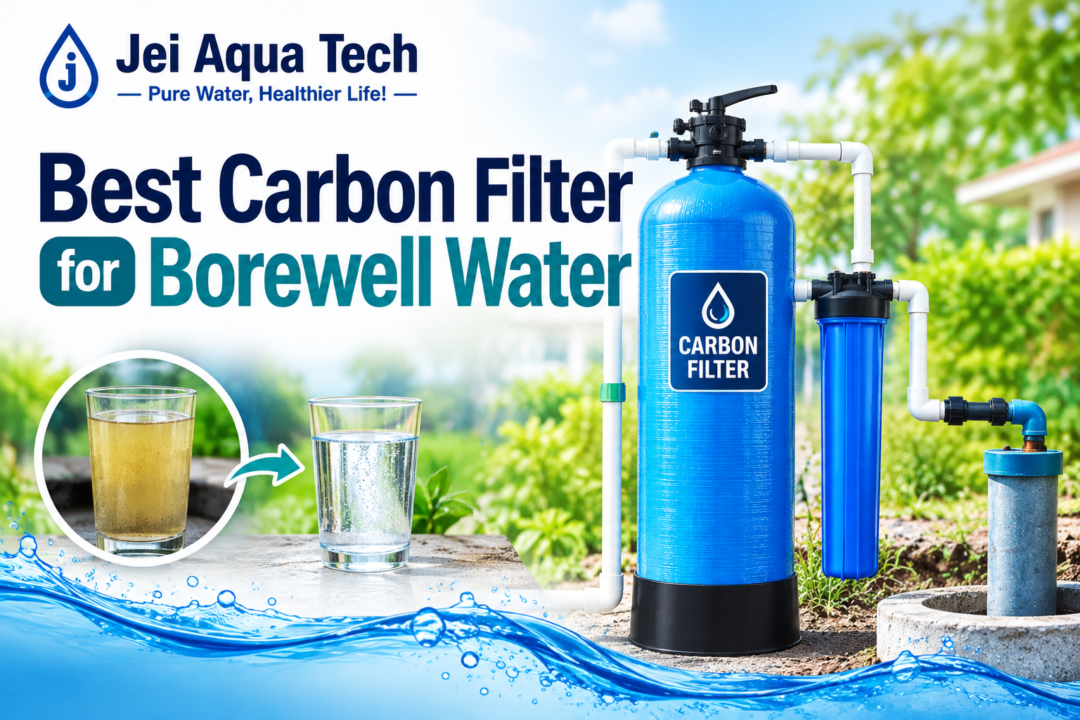
Borewell water is commonly used for homes, apartments, commercial buildings, and industries. However, depending on the groundwater source, borewell water may contain unpleasant odour, taste, chlorine, organic impurities, suspended particles, and other contaminants that can affect overall water quality.
A carbon filter for borewell water can be an effective treatment stage for improving taste and odour and reducing certain organic contaminants. However, choosing the right carbon filter is important because not every borewell water source has the same quality.
The best carbon filter should be selected according to the water test results, flow requirement, daily consumption, filter capacity, carbon media, and the other treatment systems being used.
What Is a Carbon Filter?
A carbon filter is a water filtration system that uses activated carbon media to adsorb certain contaminants from water.
Activated carbon has a highly porous structure that provides a large surface area for adsorption. As water passes through the carbon media, certain unwanted compounds can be retained by the carbon.
Carbon filtration is commonly used to improve:
- Water taste
- Water odour
- Chlorine-related taste and smell
- Certain organic compounds
- Some colour-causing compounds
The actual performance depends on the type and quality of carbon media, contact time, water quality, and system design.
Why Use a Carbon Filter for Borewell Water?
Borewell water quality can vary considerably between locations. Some borewell sources may have an unpleasant smell or taste that makes the water less suitable for certain applications.
A carbon filter can be used as part of a water treatment system when the water contains contaminants that can be reduced through activated carbon adsorption.
It may also be used as a pre-treatment stage before other filtration systems.
However, carbon filtration should not be considered a universal solution for every borewell-water problem. If the water contains high iron, hardness, high TDS, or other specific contaminants, additional treatment may be required.
What Does a Carbon Filter Remove?
The contaminants reduced by a carbon filter depend on the carbon type and system design.
Activated carbon can be effective for reducing certain:
- Organic compounds
- Chlorine
- Unpleasant tastes
- Unpleasant odours
- Colour-causing substances
- Other adsorbable contaminants
If your borewell water has high iron or hardness, a separate treatment system may be required.
For example, an Iron Removal Filter is designed specifically for excess iron, while a Water Softener is used to address hardness.
How Does a Carbon Filter Work?
The basic working process is straightforward.
Raw water enters the carbon filter vessel and flows through the activated carbon media. As the water passes through the media, certain contaminants are adsorbed onto the carbon surface.
The treated water then exits through the outlet and continues to the next stage of the water treatment system.
A simplified process is:
Raw Water → Activated Carbon Media → Adsorption → Filtered Water
The effectiveness of the system depends on the amount of carbon, flow rate, contact time, water quality, and condition of the media.
How to Choose the Best Carbon Filter for Borewell Water?
There is no single carbon filter that is best for every borewell. The right system should be selected based on the actual water condition.
1. Test Your Borewell Water
Water testing should be the first step before selecting a filtration system.
Important parameters may include:
- TDS
- pH
- Hardness
- Iron
- Turbidity
- Chlorine
- Colour
- Odour
- Other relevant contaminants
Testing helps determine whether carbon filtration is appropriate and whether additional treatment is necessary.
2. Identify the Main Water Problem
The filter should be selected based on the problem you are trying to solve.
If the main issue is unpleasant taste or odour, activated carbon may be useful.
If the primary problem is iron, an Iron Removal Filter may be more appropriate.
If hardness is the main issue, a Water Softener may be required.
If TDS is high, an RO system may be necessary.
In some applications, multiple treatment stages may be used together.
3. Consider Water Flow Rate
The carbon filter should be able to handle the required water flow.
A small household may require a different flow rate from an apartment, hotel, restaurant, or industrial facility.
If water flows too quickly through the carbon bed, there may not be enough contact time for effective adsorption.
Therefore, flow rate is an important factor when selecting the filter size.
4. Select the Correct Carbon Media
Different types of activated carbon can have different characteristics and applications.
Common carbon media types include:
Coconut Shell Activated Carbon: Often used for applications involving chlorine and certain organic compounds.
Coal-Based Activated Carbon: Commonly used in various commercial and industrial water-treatment applications.
Other Specialized Carbon Media: Certain applications may require specially selected carbon based on the contaminants present.
The appropriate media should be selected according to the water-quality requirements rather than simply choosing based on price.
Carbon Filter Capacity
Carbon filters are available in different vessel sizes and capacities.
The required size depends on:
- Water flow
- Daily water consumption
- Contaminant concentration
- Required contact time
- Application
- Available installation space
For a residential system, a compact carbon filter may be sufficient. Larger homes, apartments, commercial buildings, and industrial facilities may require larger vessels or multiple filtration units.
A professional water-treatment assessment can help determine the appropriate capacity.
Carbon Filter for RO Plant Pre-Treatment
A carbon filter is commonly used as part of pre-treatment in certain RO systems.
A typical treatment arrangement may include:
Raw Water → Sand Filter → Carbon Filter → Micron Filter → RO Plant
The exact configuration depends on the raw water quality.
Carbon filtration can help reduce certain contaminants before water reaches the RO membrane. This may be particularly important where chlorine or organic contaminants could affect downstream components.
For borewell water, additional pre-treatment such as a Sand Filter or Iron Removal Filter may be necessary depending on the water analysis.
Carbon Filter for Home Borewell Water
For residential borewell water, the correct carbon filter should be selected based on household consumption and water quality.
A carbon filter can be useful when the primary concerns include:
- Bad taste
- Unpleasant odour
- Certain organic contaminants
- Chlorine, where present
- Colour-related issues that are treatable through carbon adsorption
However, if the borewell water contains high iron, high hardness, or high TDS, carbon filtration alone may not solve the problem.
Testing the water before installation helps avoid selecting an unsuitable treatment system.
Carbon Filter for Apartments and Commercial Buildings
Apartments and commercial buildings typically have higher water demand than individual homes.
A larger carbon filter system may be required to handle the required flow while maintaining adequate contact time.
The system should be designed according to:
- Number of users
- Peak water demand
- Daily consumption
- Water source
- Raw water quality
- Required treatment stages
For larger installations, professional system sizing is particularly important.
Carbon Filter Maintenance
Regular maintenance is necessary to maintain filtration performance.
Depending on the system, maintenance may include:
- Backwashing
- Checking water flow
- Inspecting the control valve
- Checking pressure
- Inspecting carbon media
- Checking pipelines and connections
- Cleaning the filter vessel
- Replacing carbon media when required
The maintenance frequency depends on the water quality and system usage.
When Should Carbon Filter Media Be Replaced?
Activated carbon has a limited adsorption capacity. Over time, the media becomes loaded with contaminants and its effectiveness can decrease.
Media replacement may be required when:
- Taste or odour returns
- Water quality decreases
- Carbon adsorption performance reduces
- The media has reached its expected service life
- Water usage has increased significantly
- Raw water quality has changed
There is no universal replacement interval because carbon life depends on the type of carbon, contaminant concentration, water flow, and usage.
Carbon Filter vs Iron Removal Filter
These two systems are designed for different purposes.
A carbon filter primarily uses adsorption to reduce certain organic compounds, chlorine, taste, and odour.
An Iron Removal Filter is designed specifically to reduce excess iron from water.
If your borewell water contains both iron and organic contaminants, both systems may be included in the treatment process when appropriate.
Water testing is the best way to determine the correct treatment combination.
Carbon Filter vs Sand Filter
A sand filter primarily reduces suspended particles, sediment, dirt, and other physical impurities.
A carbon filter works mainly through adsorption.
In some water treatment systems, both are installed as separate treatment stages.
For example:
Raw Water → Sand Filter → Carbon Filter → RO
The sand filter can handle suspended particles while the carbon filter addresses contaminants suitable for activated-carbon adsorption.
Common Carbon Filter Problems
A carbon filter may experience performance problems due to several reasons.
Reduced Water Flow
Clogged media, excessive sediment, or pipeline restrictions can reduce water flow.
Bad Taste or Odour Returns
This may indicate that the carbon media has become exhausted or that the incoming water quality has changed.
Poor Filtration Performance
Incorrect sizing, insufficient contact time, poor-quality media, or improper maintenance can affect performance.
Backwash Problems
For systems designed for backwashing, valve or plumbing issues can prevent proper cleaning.
Professional inspection can help identify the actual cause.
Why Choose Professional Carbon Filter Installation?
Installing the correct carbon filter involves more than selecting a vessel and filling it with carbon.
The system should be designed according to:
- Water quality
- Flow requirement
- Carbon type
- Vessel size
- Contact time
- Backwash requirements
- Installation space
- Other treatment stages
Professional installation helps ensure that the system is correctly connected and configured for the intended application.
Carbon Filter Service in Chennai
If your existing carbon filter is showing reduced flow, returning odour, poor filtration, or media-related problems, professional service can help.
Jei Aqua Tech provides carbon filter installation, maintenance, repair, cleaning, and media replacement support in Chennai.
Our services can be considered for:
- Homes
- Apartments
- Offices
- Hotels
- Restaurants
- Commercial buildings
- Industrial applications
- RO pre-treatment systems
Get the Best Carbon Filter for Borewell Water in Chennai
The best carbon filter for borewell water is not necessarily the cheapest or largest model. It should be selected according to your actual water quality, flow requirement, daily consumption, and treatment objective.
If your borewell water has bad taste, unpleasant odour, certain organic impurities, or requires carbon filtration as part of an RO pre-treatment system, a properly designed carbon filter can be an effective solution.
At Jei Aqua Tech, we provide carbon filter solutions and water-treatment services in Chennai. Contact us to discuss your borewell water quality and determine the appropriate carbon filtration system for your requirement.

Written by Seoadmin

-
Sale Product on sale
 300 GPD Hi-Tech RO Membrane
₹ 3,500Original price was: ₹ 3,500.₹ 2,700Current price is: ₹ 2,700. -
Sale Product on saleVontron 300 Gpd RO Membrane
₹ 3,500Original price was: ₹ 3,500.₹ 3,000Current price is: ₹ 3,000. -
Sale Product on sale300 Gpd Healthy RO Membrane
₹ 4,200Original price was: ₹ 4,200.₹ 3,700Current price is: ₹ 3,700. -
Sale Product on saleCsm 80 GPD Membrane
₹ 2,500Original price was: ₹ 2,500.₹ 1,600Current price is: ₹ 1,600.

-
Sale Product on sale50 LPH RO+Hot+Cold Water Dispenser
₹ 82,000Original price was: ₹ 82,000.₹ 75,000Current price is: ₹ 75,000. -
Sale Product on sale25 LPH RO+Hot+Cold Water Dispenser
₹ 66,000Original price was: ₹ 66,000.₹ 64,900Current price is: ₹ 64,900. -
Sale Product on saleNormal+Hot+Cold Water Dispenser
₹ 58,500Original price was: ₹ 58,500.₹ 57,800Current price is: ₹ 57,800.
Leave a Reply
You must be logged in to post a comment.