
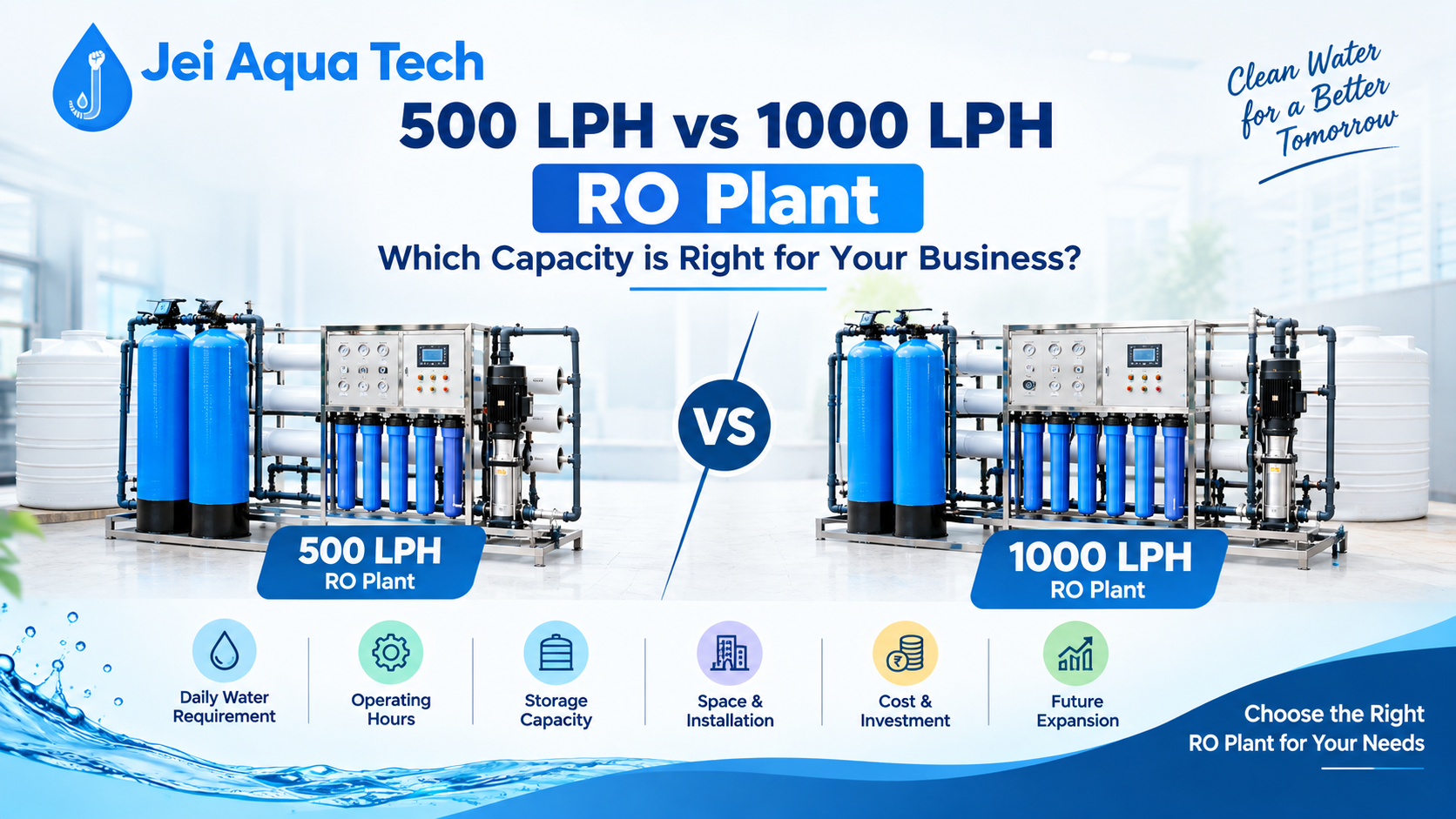
Choosing the correct RO plant capacity is important for businesses that need a regular supply of purified water. Two commonly considered options are a 500 LPH RO Plant and a 1000 LPH RO Plant.
The right choice depends on factors such as daily water consumption, operating hours, peak demand, available space, raw-water quality and future expansion plans.
In this guide, Jei Aqua Tech explains the key differences between a 500 LPH vs 1000 LPH RO Plant and how businesses can select a suitable capacity.
What Does LPH Mean in an RO Plant?
LPH stands for Litres Per Hour. It indicates the approximate amount of purified water an RO plant is designed to produce per hour under specified operating conditions.
For example:
- 500 LPH RO Plant → designed for approximately 500 litres of treated water per hour
- 1000 LPH RO Plant → designed for approximately 1000 litres of treated water per hour
Actual output can vary depending on feed-water quality, temperature, pressure, membrane condition and system configuration.
Therefore, LPH should be considered along with your actual water requirement rather than as the only selection factor.
500 LPH vs 1000 LPH RO Plant
The main difference is production capacity.
Feature | 500 LPH RO Plant | 1000 LPH RO Plant |
Approx. rated production | 500 litres/hour | 1000 litres/hour |
Suitable for | Smaller commercial requirements | Higher commercial requirements |
Daily production potential* | Depends on operating hours | Depends on operating hours |
Space requirement | Generally lower | Generally higher |
Initial investment | Generally lower | Generally higher |
Water demand | Moderate | Higher |
Future expansion | Suitable for moderate growth | More capacity for increasing demand |
*Actual production depends on operating conditions and system design.
1. When Is a 500 LPH RO Plant Suitable?
A 500 LPH RO Plant can be considered when the business has a moderate purified-water requirement.
Potential applications include:
- Small and medium restaurants
- Cafeterias
- Hotels
- Schools
- Offices
- Small manufacturing units
- Commercial establishments
- Water distribution applications
For example, if a plant operates for 8 hours at its rated production, the theoretical rated production would be:
500 × 8 = 4,000 litres
This is a simple capacity calculation. Actual usable output should be determined based on the plant’s operating conditions and required downtime.
A 500 LPH system can therefore be suitable when the required daily production does not justify a larger-capacity system.
2. When Is a 1000 LPH RO Plant Suitable?
A 1000 LPH RO Plant is designed for a higher water-production requirement.
It may be considered for:
- Large restaurants
- Hotels
- Hospitals
- Schools and institutions
- Commercial buildings
- Food-processing applications
- Manufacturing units
- Larger water-supply requirements
At a rated output of 1000 litres per hour, operating for 8 hours would give a theoretical production of:
1000 × 8 = 8,000 litres
Again, actual production depends on the feed-water characteristics, RO design and operating conditions.
3. Compare Your Daily Water Requirement
Before choosing between a 500 LPH and 1000 LPH RO plant, calculate your approximate daily purified-water requirement.
Use:
Required hourly production = Daily water requirement ÷ Operating hours
Example
Suppose a business requires approximately 6,000 litres of purified water per day and plans to operate the RO plant for 8 hours.
6,000 ÷ 8 = 750 LPH
In this example, a 500 LPH plant would not provide the required rated production within 8 operating hours, while a 1000 LPH plant provides a higher rated capacity.
However, the final selection should also consider storage capacity, peak demand, operating schedule and the manufacturer’s design calculations.
4. Consider Peak Water Demand
Daily consumption is not the only factor.
A business may use much more water during particular periods.
For example, restaurants may experience higher consumption during meal hours, while hotels may have variable demand depending on occupancy.
Ask yourself:
- When is water consumption highest?
- How many litres are required during peak periods?
- Can purified water be stored in a tank?
- How many hours can the RO plant operate each day?
If demand is spread throughout the day, a smaller RO plant combined with adequate storage may be sufficient for the application.
5. Storage Tank Capacity Also Matters
The RO plant and storage system should be considered together.
Suppose purified water is produced gradually throughout the day but consumed heavily during a short period. A storage tank can help bridge the difference between production and peak consumption.
Therefore, don’t select an RO plant based only on the statement:
“We need 5,000 litres per day.”
Instead, consider:
Daily requirement + operating hours + peak consumption + storage capacity
This provides a more practical basis for selecting the plant size.
6. Raw-Water Quality Affects RO Plant Design
Capacity isn’t the only technical consideration.
Before designing an RO system, raw water should be tested for relevant parameters such as:
- TDS
- pH
- Hardness
- Turbidity
- Iron
- Chloride
- Other application-specific parameters
Depending on the raw-water quality, pretreatment may be required.
A typical treatment arrangement could include:
Raw Water → Pressure Sand Filter → Activated Carbon Filter → Softener → Micron Filter → RO Plant
The exact configuration should be based on the water analysis and application requirements.
7. 500 LPH vs 1000 LPH: Consider Future Growth
Your current water requirement may not remain the same.
A business might expand its production, add more employees, increase customer volume or introduce new operations.
If your current requirement is close to the capacity of a 500 LPH plant, you should discuss future requirements with the manufacturer before making a decision.
On the other hand, installing a significantly larger plant than your actual requirement may not be necessary.
The objective is to select a capacity that matches the application and expected demand.
8. Installation Space and Utilities
Before choosing a capacity, check the available installation area.
Discuss with the RO plant manufacturer:
- Equipment dimensions
- Raw-water connection
- Purified-water connection
- Reject-water drainage
- Electrical requirements
- Storage tank location
- Pretreatment equipment
- Maintenance access
A 1000 LPH system may require more space depending on its configuration and pretreatment arrangement.
9. Don’t Compare Only the RO Plant Price
When comparing a 500 LPH vs 1000 LPH RO Plant, the equipment price is only one part of the decision.
Consider the complete project:
RO Plant + Pretreatment + Storage + Installation + Electrical Work + Plumbing + Consumables + Maintenance
Ask the supplier for a detailed quotation that clearly identifies what is included.
This makes it easier to compare different RO plant suppliers on the same basis.
10. 500 LPH or 1000 LPH: Questions to Ask
Before finalizing your RO plant, ask the manufacturer:
- What is my actual daily water requirement?
- How many hours will the plant operate?
- What is the peak water demand?
- What is the raw-water quality?
- Is pretreatment required?
- What is the expected permeate recovery?
- What storage capacity is recommended?
- What electrical supply is required?
- What maintenance is required?
- What warranty and service support are included?
These questions can help you understand the complete system rather than selecting a plant based only on LPH.
500 LPH vs 1000 LPH RO Plant: Quick Decision Guide
Consider a 500 LPH RO Plant if:
- Your purified-water requirement is moderate.
- Your daily demand can be met within your planned operating hours.
- You have limited installation space.
- Your expected future demand is relatively stable.
- A smaller-capacity system matches your application.
Consider a 1000 LPH RO Plant if:
- Your water requirement is significantly higher.
- You need greater production within the same operating period.
- Your business has higher peak demand.
- You expect water consumption to increase.
- Your site and utilities can accommodate the larger system.
Why Choose Jei Aqua Tech for RO Plant Requirements?
Jei Aqua Tech provides RO plant solutions for commercial and industrial water-treatment requirements.
The appropriate plant capacity can vary according to your water source, raw-water quality, daily consumption, operating hours, application and future requirements.
Instead of selecting a plant only by capacity or price, a proper assessment of the complete water-treatment requirement can help determine whether a 500 LPH RO Plant, 1000 LPH RO Plant, or another capacity is appropriate.
Final Thoughts
The choice between a 500 LPH vs 1000 LPH RO Plant ultimately depends on how much purified water your business needs and how quickly it needs that water.
A 500 LPH system may suit moderate requirements, while a 1000 LPH system provides a higher rated production capacity for applications with greater demand.
Before purchasing, evaluate your daily consumption, operating hours, peak demand, raw-water quality, pretreatment requirements, storage and future growth.
For businesses in Chennai and surrounding areas, Jei Aqua Tech can help assess the application and determine a suitable RO plant capacity based on the site’s water-treatment requirements.

Written by Seoadmin

-
Sale Product on sale
 300 GPD Hi-Tech RO Membrane
₹ 3,500Original price was: ₹ 3,500.₹ 2,700Current price is: ₹ 2,700. -
Sale Product on saleVontron 300 Gpd RO Membrane
₹ 3,500Original price was: ₹ 3,500.₹ 3,000Current price is: ₹ 3,000. -
Sale Product on sale300 Gpd Healthy RO Membrane
₹ 4,200Original price was: ₹ 4,200.₹ 3,700Current price is: ₹ 3,700. -
Sale Product on saleCsm 80 GPD Membrane
₹ 2,500Original price was: ₹ 2,500.₹ 1,600Current price is: ₹ 1,600.

-
Sale Product on sale50 LPH RO+Hot+Cold Water Dispenser
₹ 82,000Original price was: ₹ 82,000.₹ 75,000Current price is: ₹ 75,000. -
Sale Product on sale25 LPH RO+Hot+Cold Water Dispenser
₹ 66,000Original price was: ₹ 66,000.₹ 64,900Current price is: ₹ 64,900. -
Sale Product on saleNormal+Hot+Cold Water Dispenser
₹ 58,500Original price was: ₹ 58,500.₹ 57,800Current price is: ₹ 57,800.
Leave a Reply
You must be logged in to post a comment.