
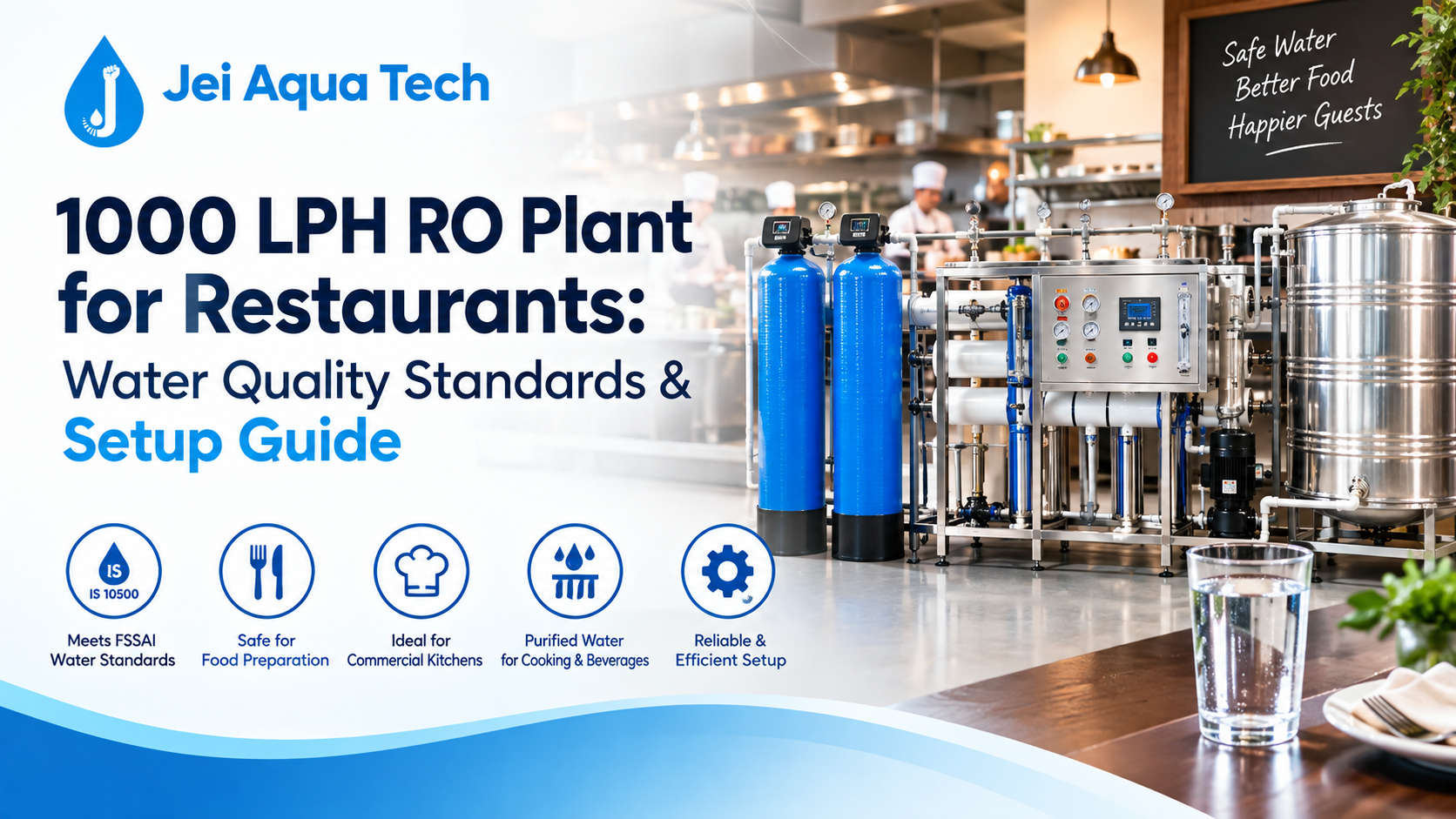
For a restaurant, water is used for much more than drinking. It is required for cooking, food preparation, making beverages and ice, washing ingredients, cleaning food-contact surfaces, and other daily operations. Because water directly interacts with food and customers, maintaining consistent water quality is an important part of restaurant hygiene.
A 1000 LPH RO Plant for restaurants can be a practical commercial water-treatment solution when a restaurant needs a continuous supply of purified water. The system can be designed according to the raw-water quality, daily consumption, required treatment level and available installation space.
For food businesses, FSSAI’s hygiene requirements state that water used as an ingredient or in contact with food or food-contact surfaces should be potable and meet the latest BIS drinking-water standard, IS 10500. FSSAI guidance also calls for potable-water analysis at least semi-annually in applicable food-business operations.
This guide explains how a 1000 LPH commercial RO system works, what restaurants should consider before installation, and how to plan the right setup.
What Is a 1000 LPH RO Plant?
LPH means Litres Per Hour.
A 1000 LPH RO plant is designed to produce approximately 1,000 litres of treated water per hour under its specified operating conditions.
For a restaurant, this capacity can support applications such as:
- Drinking water
- Cooking
- Food preparation
- Beverage preparation
- Ice-making feed water
- Kitchen operations
- Staff drinking water
- Other applications requiring treated water
The actual daily production depends on operating hours, feed-water conditions, recovery rate, maintenance and system design.
For example, if a plant operates for 8 hours, its nominal production capacity is:
1,000 litres/hour × 8 hours = 8,000 litres/day
This does not mean every restaurant needs to operate the plant for eight hours continuously. Storage tanks can be used so treated water is available during peak kitchen and service periods.
Why Do Restaurants Need a Commercial RO Plant?
Water quality can directly affect food preparation and the performance of kitchen equipment.
Depending on the source, raw water may contain:
- High TDS
- Hardness
- Suspended particles
- Chlorine
- Unpleasant odour
- Iron
- Organic impurities
- Other dissolved contaminants
An RO system can reduce many dissolved substances, but RO should not be selected blindly. The treatment process should be designed after testing the source water.
For a restaurant using borewell water, for example, the treatment requirement may be very different from a restaurant receiving treated municipal water.
That is why a professional 1000 LPH RO plant for restaurants should be designed around the actual feed-water report.
FSSAI Water Quality Requirements for Restaurants
One important point for restaurant owners is that an RO plant itself does not automatically make water “FSSAI compliant.”
The final water quality needs to meet the applicable potable-water requirements.
FSSAI’s food-business hygiene requirements specify that potable water used as an ingredient or in contact with food or food-contact surfaces should conform to the latest BIS drinking-water standard, IS 10500. Water should also be analysed at the required frequency, and water filters should be properly maintained.
FSSAI’s hygiene-rating material similarly refers to potable water meeting IS 10500 and maintaining appropriate testing records.
The Bureau of Indian Standards identifies IS 10500 as the specification for drinking water intended for human consumption.
Therefore, restaurant owners should think about the complete process:
Raw Water Testing → Treatment Design → RO Plant → Post-Treatment → Storage → Water Testing
rather than focusing only on RO capacity.
How Does a 1000 LPH RO Plant Work?
A typical commercial RO plant consists of several treatment stages.
The exact configuration varies according to the raw-water quality.
1. Raw Water Storage
Raw water is first collected in a suitable storage tank.
This provides a consistent feed supply to the treatment system.
2. Pressure Sand Filter
A pressure sand or multimedia filter can remove suspended particles and reduce turbidity before the water reaches the RO section.
This helps protect downstream equipment.
3. Activated Carbon Filter
An activated carbon filter can help reduce chlorine, odour, colour and certain organic compounds.
Carbon treatment is particularly important when chlorine control is required before RO membranes.
4. Micron Filtration
A cartridge or micron filter provides finer pre-filtration before the high-pressure RO stage.
It helps protect the RO membranes from smaller suspended particles.
5. High-Pressure Pump
The high-pressure pump supplies the pressure required for the RO membranes to operate.
6. RO Membranes
Reverse osmosis uses a semi-permeable membrane to separate a large portion of dissolved salts and other impurities from the feed water.
The system produces two streams:
Permeate → Treated water
Reject → Concentrated wastewater stream
The recovery and rejection rates depend on feed-water quality, membrane configuration and operating conditions.
7. Post-Treatment
Depending on the application, additional treatment may be installed after RO.
Possible options include:
- UV disinfection
- UF
- Micron filtration
- Mineral balancing/remineralisation
- Other application-specific treatment
The correct post-treatment should be selected based on water testing and the intended use.
Typical 1000 LPH RO Plant Setup for a Restaurant
A commercial restaurant system may follow a sequence such as:
Raw Water Tank
↓
Feed Pump
↓
Sand / Multimedia Filter
↓
Activated Carbon Filter
↓
Micron Cartridge Filter
↓
High-Pressure Pump
↓
RO Membranes
↓
Post-Treatment
↓
Treated Water Storage Tank
↓
Kitchen / Drinking Water Supply
The actual configuration can be modified depending on the source water.
For example, a restaurant using high-hardness borewell water may require additional pre-treatment before the RO stage.
How Much Water Does a Restaurant Need?
Capacity selection should not be based only on the restaurant’s number of customers.
Consider the total water requirement from:
- Number of meals served
- Drinking-water consumption
- Cooking
- Food preparation
- Beverage production
- Ice production
- Staff consumption
- Kitchen processes
- Operating hours
- Peak-hour demand
A restaurant may therefore need a storage tank even when a 1000 LPH plant is sufficient in terms of hourly capacity.
For example, if the kitchen requires a large quantity of treated water during lunch and dinner periods, storing treated water in advance can reduce pressure on the RO plant during peak demand.
1000 LPH RO Plant vs Smaller RO System
A domestic RO purifier is designed for household-scale drinking-water requirements.
A restaurant, however, may need a much larger and more consistent supply.
A 1000 LPH commercial RO plant is suitable when the restaurant has significantly higher treated-water requirements than a domestic purifier can provide.
The major advantages include:
- Higher production capacity
- Continuous commercial operation
- Centralised water treatment
- Easier maintenance access
- Integration with storage tanks
- Ability to add pre-treatment
- Suitable for larger kitchen requirements
The plant should still be correctly sized. A larger RO plant is not automatically better if the restaurant’s actual requirement is much lower.
Importance of Pre-Treatment
One of the most important parts of a commercial RO plant is the pre-treatment section.
RO membranes can be affected by:
- Suspended solids
- Chlorine
- Hardness
- Iron
- Fouling
- Scaling
Proper pre-treatment can improve membrane performance and help extend membrane life.
For this reason, restaurants should not compare RO plants only by the number of membranes or the advertised LPH capacity.
A better comparison includes:
Raw-water testing + pre-treatment + RO design + post-treatment + storage + automation + maintenance
What Water Tests Should a Restaurant Consider?
Before installing a 1000 LPH RO plant, the source water should be tested.
Depending on the source and intended use, testing may include parameters such as:
- TDS
- pH
- Hardness
- Turbidity
- Iron
- Chloride
- Sulphate
- Alkalinity
- Microbiological parameters
- Other parameters relevant to the water source
The test report helps determine the appropriate treatment stages.
For food businesses, water testing and documentation are especially important because potable water used in food operations is part of the overall food-safety system.
Treated Water Storage for Restaurants
A properly designed storage tank is an important part of the system.
The tank should be suitable for potable-water storage and maintained to prevent contamination.
FSSAI guidance specifies that where water storage is necessary, storage facilities should be appropriately designed, made from food-grade material, cleaned periodically and maintained to prevent contamination, with records maintained.
Restaurants should also avoid allowing treated water to remain stagnant for unnecessarily long periods.
Regular cleaning and inspection of the storage tank should be included in the maintenance schedule.
RO Reject Water Management
RO produces reject water along with treated water.
Restaurant owners should plan for this water instead of simply allowing it to drain continuously.
Depending on the quality of reject water and local practices, it may potentially be reused for suitable non-potable applications such as:
- Floor cleaning
- Toilet flushing
- Gardening
- Other appropriate utility applications
The reuse application must be evaluated to ensure it does not create a food-safety risk.
Maintenance of a 1000 LPH RO Plant
Regular maintenance is essential for reliable restaurant operation.
A maintenance schedule may include:
Daily Checks
- Check leakage
- Check pressure
- Observe plant operation
- Check treated-water production
Periodic Checks
- Clean or replace cartridge filters
- Inspect pumps
- Check control panel
- Check valves and pipelines
- Monitor membrane performance
- Inspect storage tanks
Water Quality Monitoring
Regularly test treated water to confirm that the system continues to produce water suitable for its intended use.
FSSAI guidance also states that where water filters are used, they should be regularly changed or effectively maintained.
How to Choose a 1000 LPH RO Plant for Your Restaurant
Before purchasing a system, ask these questions:
1. What is the source water?
Is it borewell water, municipal water or another source?
2. What is the raw-water TDS?
TDS has a direct impact on RO design and membrane selection.
3. What is the hardness level?
High hardness may require additional pre-treatment.
4. What is the daily water requirement?
Calculate the restaurant’s actual consumption rather than choosing capacity only by guesswork.
5. How many hours will the plant operate?
Operating hours help determine whether 1000 LPH is appropriate.
6. What final water quality is required?
The intended use determines the necessary treatment and post-treatment.
7. Is there enough installation space?
Allow space for:
- Filters
- RO skid
- Pumps
- Control panel
- Storage tanks
- Maintenance access
Why Choose Jei Aqua Tech for a Commercial RO Plant?
For a restaurant, installing an RO plant is not simply about buying a 1000 LPH machine.
The system should be designed around the restaurant’s actual water requirement and source-water quality.
Jei Aqua Tech provides commercial water-treatment solutions including RO plants, filtration systems, water softeners and pre-treatment systems.
For a 1000 LPH RO Plant for restaurants, the system can be planned around:
- Raw-water testing
- Required production capacity
- Pre-treatment requirements
- RO membrane selection
- Treated-water storage
- Post-treatment
- Installation requirements
- Maintenance and service
This approach helps restaurant owners build a water-treatment system that is practical for their daily operations.
Conclusion
A 1000 LPH RO Plant for restaurants can provide a reliable source of treated water for drinking, cooking, food preparation and other suitable applications when properly designed and maintained.
However, RO capacity alone does not determine water quality. The complete system—from raw-water testing and pre-treatment to RO, post-treatment, storage and regular testing—must be considered.
For restaurants in Chennai and surrounding areas, source-water conditions can vary considerably. Therefore, testing the water before finalising the RO plant is an important first step.
FSSAI’s food-business hygiene requirements emphasise the use of potable water meeting the latest BIS IS 10500 requirements for relevant food operations, along with appropriate testing and maintenance.
If your restaurant requires a 1000 LPH commercial RO plant, Jei Aqua Tech can help assess the water source, daily requirement and treatment stages needed to develop a suitable commercial RO solution.
Jei Aqua Tech – Commercial RO Plant & Water Treatment Solutions for Restaurants and Businesses.

Written by Seoadmin

-
Sale Product on sale
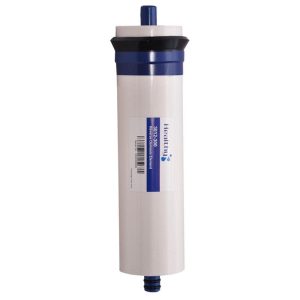
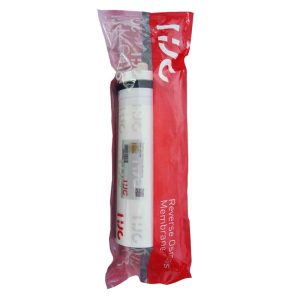
 300 GPD Hi-Tech RO Membrane
₹ 3,500Original price was: ₹ 3,500.₹ 2,700Current price is: ₹ 2,700. -
Sale Product on saleVontron 300 Gpd RO Membrane
₹ 3,500Original price was: ₹ 3,500.₹ 3,000Current price is: ₹ 3,000. -
Sale Product on sale300 Gpd Healthy RO Membrane
₹ 4,200Original price was: ₹ 4,200.₹ 3,700Current price is: ₹ 3,700. -
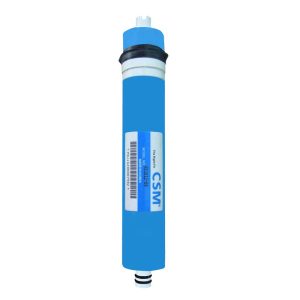
Sale Product on saleCsm 80 GPD Membrane
₹ 2,500Original price was: ₹ 2,500.₹ 1,600Current price is: ₹ 1,600.

-
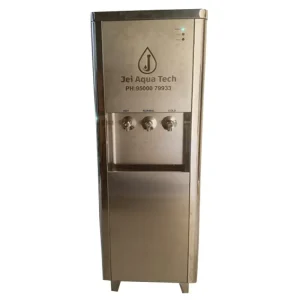
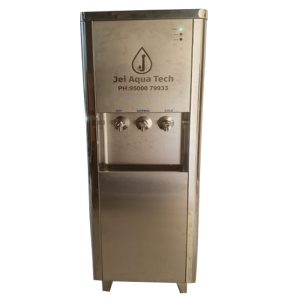
Sale Product on sale50 LPH RO+Hot+Cold Water Dispenser
₹ 82,000Original price was: ₹ 82,000.₹ 75,000Current price is: ₹ 75,000. -
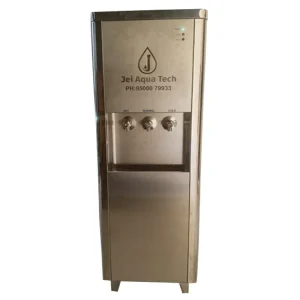
Sale Product on sale25 LPH RO+Hot+Cold Water Dispenser
₹ 66,000Original price was: ₹ 66,000.₹ 64,900Current price is: ₹ 64,900. -
Sale Product on saleNormal+Hot+Cold Water Dispenser
₹ 58,500Original price was: ₹ 58,500.₹ 57,800Current price is: ₹ 57,800.
Leave a Reply
You must be logged in to post a comment.